

Reviewed · ORLANDO ESCAPE ROOMS
2 Hours Escape Room A Knight To Escape
A Knight To Escape takes the usual escape room idea and splits it in two. Your group begins in separate parts of Stonebury Castle, with some players in the dungeon and others in the courtyard. You must communicate, solve linked puzzles, and help free your teammates before time runs out.
I like the strong medieval setting and the unusual two-hour format. The room design gets repeated praise for looking well built, and the private booking means your group does not have to work with strangers. The big concern is value: at $69.95 per person, slow puzzle flow and periods of standing around can make the experience feel expensive.
I also like that this is more than a room full of locks. You have different roles, a rescue goal, and a real need to pass information between separated teams. Still, the high difficulty, occasional clue delays, cold rooms, and uneven puzzle design mean this is best for patient escape-room fans, not anyone seeking a light, easy family activity.
In This Review
- Key points to know before booking
- Stonebury Castle begins with two separate teams
- What the two-hour itinerary feels like
- The medieval set is the strongest reason to go
- Expect a serious challenge, not a casual family game
- How the split-room design affects your group
- Is $69.95 per person fair?
- Who should book A Knight To Escape?
- Practical details that can shape the visit
- Should you book this Orlando escape room?
- FAQ
- Where does A Knight To Escape take place?
- How long does the escape room last?
- Is the group split up during the game?
- Is this a private activity?
- How difficult is the game?
- Can I cancel for a full refund?
Key points to know before booking
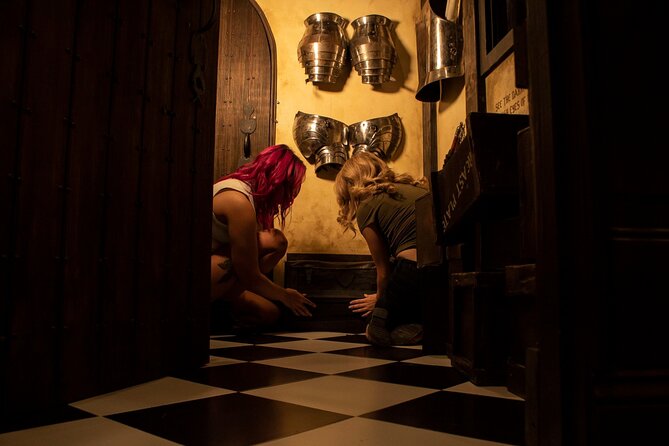
- Split-start format: Your party begins divided between a dungeon and courtyard, so communication matters from the first minute.
- Two-hour game: The longer time allows a larger story, but it does not guarantee nonstop puzzle solving.
- Hard difficulty: One account rates the challenge at 9 out of 10, so beginners may need frequent hints.
- Detailed castle set: The medieval construction and room decor are among the strongest parts of the experience.
- Private activity: Only your own group participates, which makes planning easier for families and friends.
- Bring a warm layer: The rooms may feel very cold, and one light source reportedly had trouble working properly.
Stonebury Castle begins with two separate teams
The main hook is simple and effective: your group is divided before the game begins. One side takes the role of common prisoners in the dungeon. The other plays courageous knights in the courtyard.
This setup changes the way an escape room feels. You cannot simply gather around one table and let the fastest puzzle solver take over. You need to describe objects, repeat instructions clearly, and pay attention when the other side asks for help.
The two teams can communicate, but they are not working in the same space. That creates a nice bit of pressure. A clue found in one area may be useful only after the other team completes a task. Your success depends on passing information and materials back and forth.
The goal is not just to leave your own room. You are trying to move through the castle and rescue your teammates. That shared purpose gives the game more shape than a basic sequence of unrelated locks.
Still, this format has a built-in risk. If one side is waiting for the other to finish, several people may have little to do. A party that enjoys active communication will find that tension interesting. A group that wants everyone solving at once may find the split frustrating.
More Orlando escape rooms:
- The Escape Game Orlando: Epic 60-Minute Adventures on I-Drive
★ 5.0 · 730 reviews - Tour of Lakes Escape by Personal Catamaran
★ 5.0 · 97 reviews - The Asylum Escape Room
★ 5.0 · 72 reviews
What the two-hour itinerary feels like
The activity starts at 11701 International Drive, a convenient Orlando location near public transportation. After check-in, your party receives its roles and separates into the two castle areas. The activity ends at the same meeting point, so you do not need to arrange a second pickup location.
The opening section is about getting oriented. You need to work out what can be handled, what can be read, and what may be part of the game. In a well-run escape room, this first stage teaches you the room’s logic without giving away too much.
Here, the early minutes may feel slow if your group is not used to speaking across separated spaces. You should appoint someone on each side to keep track of discoveries. Clear updates such as what you found, where it is located, and what it seems to do are far more useful than shouting a general request for help.
As the game develops, each side works through its own puzzles and sends progress to the other. The exact number of puzzles is unclear from the available information, with one experienced group estimating seven to nine meaningful puzzles. That is not a huge number for two hours.
The result depends heavily on puzzle flow. Some tasks are described as clever and tough in a satisfying way. Others have been called vague, with solutions that did not always feel clear even after completion. You might spend time testing different arrangements rather than solving a clean chain of clues.
The final stretch should feel like a race to complete the rescue. That is where the split-room design has the most dramatic potential. If both teams are moving at a good pace, the shared finish can be exciting. If one team has been waiting or working on an unclear task, the ending may feel less like a climax and more like a relief.
The medieval set is the strongest reason to go
The castle design receives the clearest praise. You are not simply placed in a plain room with a few medieval signs on the wall. The setting is described as beautiful, clean, welcoming, and well built.
That matters because a two-hour escape room needs atmosphere. The dungeon and courtyard give your group a physical story to follow. Prisoner and knight roles also help younger players understand what they are meant to do without needing a long explanation.
The decor may be especially valuable if you care about theme and photos before or after the game. It gives the experience a stronger identity than a standard puzzle room.
There are practical limits. The rooms can be cold enough that you will want a sweater or light jacket. Also, one party reported that a light source in the darker area was not working properly. That may have been a one-time problem, but lighting is important when you are reading clues and examining objects.
The room’s look is not the same thing as polished gameplay. A handsome set can make the first impression excellent, but the puzzles still need to tell you what to do. You should book this for the setting and unusual structure, while keeping your expectations measured about the game design.
Expect a serious challenge, not a casual family game
The experience is described as very challenging, and one group put the difficulty at 9 out of 10. That makes the room attractive to people who already enjoy escape rooms and do not mind asking for clues.
For a first-time group, the challenge can cut both ways. Solving a difficult puzzle together feels rewarding. But if the instructions are vague, a beginner may not know whether the problem is lack of skill or unclear design.
I recommend dividing responsibilities early. Have one person watch for patterns, another read instructions aloud, and another keep track of objects and completed tasks. Since your group is separated, each side needs its own organizer.
Do not let one difficult puzzle consume the entire game. Ask for help when your team has tested the obvious options and is repeating the same moves. The clue system exists for that reason.
The clue experience may not be instant. A message reportedly appeared saying the host would be with the group shortly, followed by waits of three or four minutes. That sounds brief in ordinary life, but during a timed game it can feel long.
One especially important point is that the game master may not constantly watch your progress. The available information indicates that help may come after you press a button rather than through active monitoring. If your team is following the wrong interpretation, you may continue for a while before anyone steps in.
That is a major consideration at this price. Some players prefer limited intervention because it keeps the challenge pure. Others expect the host to notice when a group is stuck and offer a small nudge before frustration sets in.
A few more Orlando days out to compare
- Rock Springs 2-Hour Glass Bottom Guided Kayak Eco Tour
★ 5.0 · 2,459 reviews - 2 Hour Historical Wildlife Tour of the Chain of Lakes
★ 5.0 · 293 reviews - 2-Hour Clear Kayak and Paddleboard(SUP) Rental in Orlando
★ 5.0 · 91 reviews - Private 2-Hour Day Sailing Experience
★ 5.0 · 46 reviews
How the split-room design affects your group
This is a communication game as much as a puzzle game. You will need to speak precisely, listen carefully, and trust the other side to act on information you cannot verify yourself.
That can be excellent for families, couples with friends, and office groups that enjoy solving problems together. It gives quieter players a useful role because someone must observe, remember, and report, not just grab the most obvious lock.
It can also expose weak teamwork. If players talk over one another, fail to repeat discoveries, or assume the other side has understood, progress slows quickly. You should agree on simple communication rules before the clock starts.
The chief drawback is downtime. One side may solve a task while the other waits for the result. Then the second side may work on the new item while the first waits again. Reports of 15-minute gaps between active tasks suggest that some players could spend a large portion of the game watching rather than solving.
For a group of experienced players, that is a serious weakness. For a family with mixed ages, the slower pace might be less damaging, especially if people are happy to trade roles and talk through the story.
Is $69.95 per person fair?
The price is high for an escape room. At $69.95 each, a group of four pays $279.80 before any extra costs. You are paying for a private two-hour experience, a large themed setting, and a format that is longer and more involved than a standard one-hour room.
The value is strongest when your group wants the full two-hour appointment and cares about the castle setting. You also avoid the uncertainty of being paired with other people because this is a private activity.
The value weakens if your group spends much of the session waiting. A two-hour clock sounds generous, but time alone does not create value. If only seven to nine main puzzles occupy the experience and several tasks feel unclear, you may feel the room could have been shorter and cheaper.
I would compare your expectations before booking. If you want theatrical design, a private group, and a demanding communication challenge, the price may be acceptable for a special Orlando evening. If you measure value by the number of polished puzzles solved per minute, the cost is harder to defend.
The average booking lead time is about eight days. That suggests you should not assume you can always walk in at the last minute, especially if you need a specific time for a private group. Mobile ticketing makes the reservation easy to carry on your phone.
Who should book A Knight To Escape?
I would point this room toward:
- Escape-room regulars who enjoy difficult puzzles
- Families with older children who can communicate well
- Friends looking for a private group activity
- Players who care about set design and medieval themes
- Teams that enjoy a slower, story-based challenge
I would be cautious if this is your first escape room, if anyone dislikes dark or cold rooms, or if your group gets impatient when one team must wait for another.
You should also talk with your group about the price. A person who expects constant action may come away unhappy, even if another person loves the setting. The room works best when everyone accepts that communication and persistence are part of the challenge.
Practical details that can shape the visit
The activity starts and ends at 11701 International Drive, Orlando, Florida 32821. It is near public transportation, and confirmation is provided when you book.
Service animals are allowed, and most people can participate. Since the activity is private, only your own party takes part. The supplied information does not give a minimum or maximum group size, so check the booking page for the number that fits your party.
Wear comfortable clothing and bring a sweater or jacket. The cold is not part of the advertised story, but it can affect your focus during a two-hour session.
Cancellation is free if you cancel at least 24 hours before the local start time. Changes or cancellations inside that 24-hour window are not accepted for a refund.
The experience has an overall rating of 3.8 from five ratings. That small sample points to a mixed result rather than a clear verdict. Several people enjoyed the theme, staff courtesy, family fun, and challenging puzzles. The sharpest criticism centers on puzzle flow, waiting, clue response, and value.
Should you book this Orlando escape room?
Book A Knight To Escape if you want a private, highly themed, two-hour challenge built around a clever split between dungeon and courtyard. The set design, rescue story, and need for teamwork give it a clear personality.
I would skip it if you want a tightly engineered room with nonstop activity and active game-master guidance. The price leaves little room for long waits or puzzles that only make sense after you ask for help.
My practical call: choose this for a patient group that values theme and unusual structure more than perfect puzzle mechanics. Bring a jacket, assign clear communicators, and agree that asking for clues is part of the plan. If your group has played many rooms and expects top-level design for nearly $70 per person, Orlando has other escape-room options that may offer better value.
FAQ
Where does A Knight To Escape take place?
It takes place at 11701 International Drive, Orlando, Florida 32821, USA. The activity ends back at the same meeting point.
How long does the escape room last?
The experience lasts approximately two hours.
Is the group split up during the game?
Yes. Your party is divided between the Stonebury Castle dungeon and courtyard. The two sides can communicate and must work together to rescue their teammates.
Is this a private activity?
Yes. Only your own group participates.
How difficult is the game?
The experience is described as very challenging. One account rates the difficulty at 9 out of 10, so you should expect to use teamwork and request clues when needed.
Can I cancel for a full refund?
Yes, if you cancel at least 24 hours before the experience start time. Cancellations or changes made less than 24 hours before the start are not refunded.
Just added around Orlando
- Private Shuttle Package – Orlando Int’l Airport (MCO) AIRPORT-HOTEL-SHIP-AIRPORT★ 4.0 · 3 reviews
- St. Augustine Nights of Lights Celebration from Orlando★ 4.5 · 3 reviews
- NASCAR Coke Zero 400 Race Day Packages★ 4.5 · 3 reviews
- Luxe Jet Ski Rentals★ 5.0 · 3 reviews
- Orlando: Milk District Eats Walking Food Tour★ 5.0 · 3 reviews
- Orlando: Moonshine Mixology Class with Tasting Flight★ 5.0 · 3 reviews
- Orlando: Caribbean Moonshine Distillery Tour and Tasting★ 5.0 · 3 reviews
- Orlando Airport MCO and Resort Transfer to Port Canaveral★ 5.0 · 3 reviews
Orlando Escape Rooms, compared.







Awesome Scavenger Hunt: Lake Eola’s Art Scene & Scenery
Read our review →Browse the lists this tour appears in